Mortar Smash › Trade guides › How to mix mortar
Short answer
Gauge cement, lime and sand by volume, measure the sand damp and loose, and mix with as much water as still handles on the trowel. For cement-lime Type N at 1 part lime, BIA Technical Note 8 (March 2020) Table 1 puts the sand at 5 to 6 parts. Use the batch within 2½ hours of mixing, or within 2 hours in hot weather. Add water back only to replace what evaporated, and throw the batch away once it has begun to set. Which letter you are gauging is in mortar types N, S, M and O.
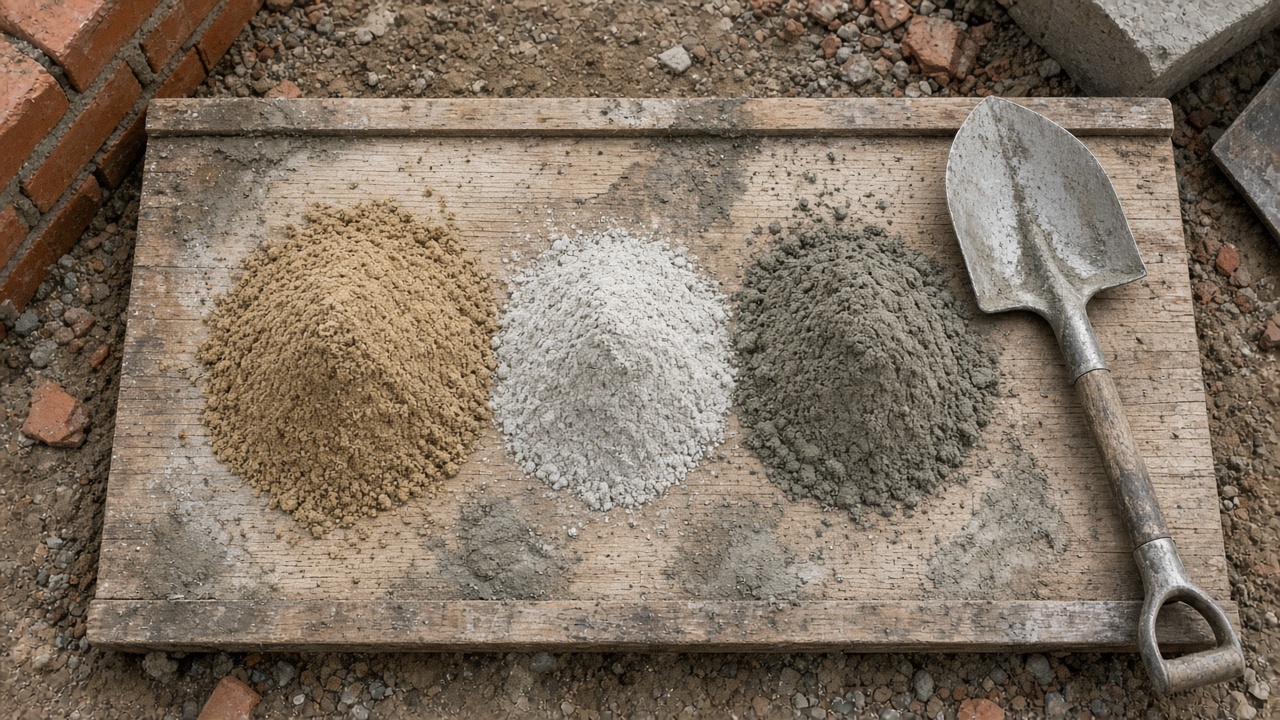
The volume band, not a single sacred ratio
Table 1 is the proportion specification. If the project specification does not say proportion or property, this table is the default. No laboratory test is required for a proportion batch. Cement-lime mortar is 1 part cement and a lime band. Sand is not less than 2½ and not more than 3 times the sum of those cementitious volumes, measured damp and loose.
| Type | Cement | Lime or lime putty | One point inside the sand band |
|---|---|---|---|
| M | 1 | ¼ | Cementitious volume 1¼. Sand 3⅛ to 3¾. |
| S | 1 | over ¼ to ½ | At ½ lime, volume 1½. Sand 3¾ to 4½. |
| N | 1 | over ½ to 1¼ | At 1 lime, volume 2. Sand 5 to 6. |
| O | 1 | over 1¼ to 2½ | At 2 lime, volume 3. Sand 7½ to 9. |
The familiar 1:1:6 mix is the top of the Type N band when the lime is 1 part (3 times a cementitious volume of 2). A 1:1:5 mix is the bottom of that same band (2½ times 2). It is not a different type. The property specification uses another aggregate band, 2¼ to 3½ times, and that band is for laboratory mortar. Do not gauge a site proportion batch to the laboratory band.
Masonry cement and mortar cement are separate rows. Technical Note 8 says to use them alone with sand, without lime. Type N masonry cement or mortar cement can be combined with portland cement when the intended type is M or S. Read the bag. A "general purpose" masonry cement is not a pile of portland cement plus lime you assemble yourself. Factory dry mixes are in preblended vs site-mixed mortar. The sand itself has to meet ASTM C144, which is the subject of building sand vs sharp sand.
Water: as much as still handles
Technical Note 8 treats water as the part of mortar people copy from concrete and get wrong. Mortar is placed against brick that absorbs water. Concrete is placed in forms that absorb little. The note says many specifications incorrectly demand the minimum water consistent with workability and forbid retempering. Mortar mixed that way tends to show higher compressive strength and lower bond. Mixing with the maximum water that is still workable gives the maximum bond the mortar can develop. The bricklayer sets that water by the way the mortar sits on the trowel. There is no litres-per-bag figure in the note, because sand moisture changes the water the board needs.
Retempering, adding water to replace what has evaporated on the board, "should be encouraged, when necessary." Compressive strength may drop slightly and the color may lighten. Bond can suffer more if stiff mortar is used without that water. The limit is time, not a ban. The note says ASTM C270 requires all mortar to be used within 2½ hours after mixing, because it will begin to set, and that the usual site control is 2½ hours after initial mixing, or 2 hours in hot-weather construction. Mortar that has begun to set is not brought back with water. Hot-weather practice on this site is in hot weather bricklaying, and the clock is spelled out in how long mortar stays usable.
Two batches do not get retempered even inside the clock. Colored mortar: the note says not to retemper it, because extra water dilutes the color. Mix a smaller batch instead, which is the point of colored mortar. Historic repointing mortar is stricter still, and that limit lives on the repointing guide, not in Table 1.
A board sequence that matches the note
- Use one gauge box or one marked bucket for the whole day. Table 1 is a volume specification. Shovelfuls drift, and the drift shows up as bands of color and strength.
- Dry-blend cement and lime with the sand until the color is even, then add water. The note does not give a mixing-machine rule. It does say the materials have to be the ones specified.
- Stop at the wettest mix that still handles. That is the bond recommendation above, not a preference for a dry, crumbly heap.
- Measure sand damp and loose, which is how Table 1 defines the ratio. Wet sand already holds water, so the water you add from the barrel goes down. Do not "correct" that by adding dry sand until the heap looks like yesterday's.
- Retemper evaporated water inside 2½ hours (2 hours in hot weather). Discard mortar that has begun to set. Colored batches stay smaller so they are used without retempering.
Bag counts for a wall, once this ratio is fixed, are in the mortar calculator. The calculator does not choose the type.
Mixing FAQ
How much sand goes in cement-lime Type N?
BIA Technical Note 8 (March 2020), Table 1, sets cement-lime Type N at 1 part cement and over ½ to 1¼ parts hydrated lime or lime putty. Sand, measured damp and loose, is 2½ to 3 times the combined cementitious volume. At 1 part lime the cementitious volume is 2, so the sand is 5 to 6 parts. A 1:1:6 mix is the top of that band.
How much water should mortar have?
BIA Technical Note 8 says the bricklayer should choose the water that gives the best workability, and that the maximum water still consistent with workability gives the maximum bond. Specifying the minimum water, and banning retempering, is described in that note as a mistake borrowed from concrete practice.
Can I add water to mortar that has stiffened on the board?
Yes, when the stiffening is water lost to evaporation, and only inside the time limit. Technical Note 8 says that retempering should be encouraged when necessary. Do not retemper colored mortar. Do not use mortar that has begun to set.
How long after mixing can mortar still be used?
Technical Note 8 says ASTM C270 requires mortar to be used within 2½ hours after mixing, because it will begin to set, and that hot-weather construction uses 2 hours after initial mixing. The timing page on this site follows that note.
Do I add lime to masonry cement?
No. Technical Note 8, Table 1, says masonry cement and mortar cement are used alone with sand, without lime, to produce types M, S, N and O. Type N masonry cement or mortar cement may be combined with portland cement when the mix is meant to be Type M or Type S.
Should the gauge be by volume or by weight?
The proportion specification, which Technical Note 8 says is the default when neither route is named, is by volume. Sand is measured damp and loose. Weight batching belongs to the laboratory property tests, not to a site proportion batch.
Sources
- BIA Technical Note 8, Mortars for Brickwork (March 2020). Table 1 volumes, the water and retempering discussion, the 2½ hour and hot-weather 2 hour limits, and the instruction not to retemper colored mortar.
- ASTM C270-25 store page, checked 21 November 2026. Abstract only. Technical Note 8 attributes the 2½ hour use-after-mixing rule to ASTM C270 and cites the 2019 Annual Book. The paywalled C270-25 text was not read. If the edition on the job differs, follow that edition.
Re-read 21 November 2026. The 5 to 6, 3⅛ to 3¾, 3¾ to 4½ and 7½ to 9 sand figures are the Table 1 multiplier applied to one lime figure inside each printed band. Codes and project specifications differ by country and job; where they conflict with this page, follow them. This is general information, not engineering advice.